

Sahabat Insurance and BNI Multi Finance exhibition

Terakhir Diubah : 09:26:29 - Thursday, 13 April 2023
Berita - Sahabat Insurance and BNI Multi Finance exhibition - Sahabat Insurance | Solusi Lengkap Perlindungan Asuransi Anda

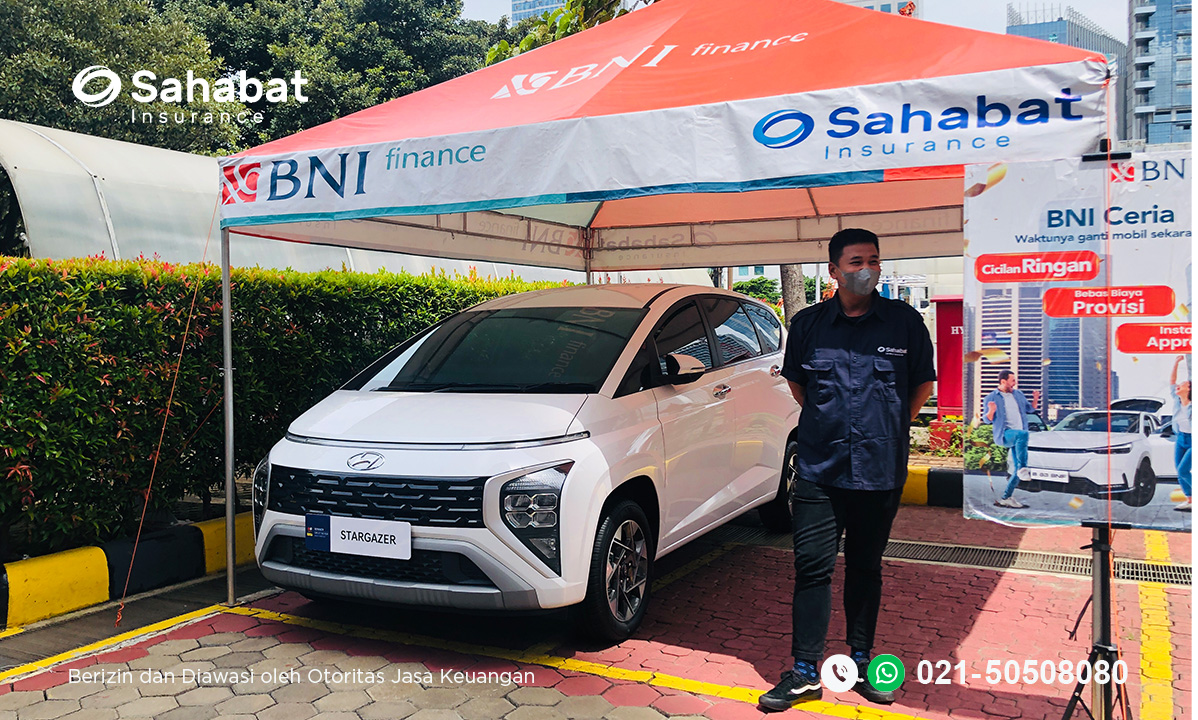
PT Asuransi Sahabat Artha Proteksi (Sahabat Insurance) and BNI Multi Finance held an exhibition on 10 – 16 April 2023 at the Grha BNI Building, Jakarta. For more information about car insurance please call 021-50508080.

Berita Lainnya

Fitch Assigns Sahabat Insurance First-Time National IFS Rating of A(idn)

Fitch Ratings - Jakarta - 12 Mar 2026: Fitch Ratings Indonesia has assigned PT Asuransi Sahabat Artha Proteksi (Sahabat Insurance) a National Insurer Financial Strength (IFS) Rating of 'A(idn)'. The Outlook is Stable.
The rating reflects a 'Moderate' company profile and stable profitability, which are offset by its lower regulatory capital ratio than peers. The rating also reflects a conservative investment approach and domestic reinsurance coverage.
'A' National IFS ratings denote a strong capacity to meet policyholder obligations relative to all other obligations or issuers in the same country or monetary union, across all industries and obligation types
KEY RATING DRIVERS
'Moderate' Company Profile: Fitch assesses Sahabat Insurance's profile based on a 'Moderate' business profile and 'Neutral' corporate governance compared with other domestic insurers. The insurer, established in 1996, was known as PT Bess Central Insurance from 2011, and changed its name to Sahabat Insurance in 2020. Sahabat Insurance's market share is small, with 0.5% of gross premiums written (GPW) in the Indonesian non-life industry in 2024.
Sahabat Insurance's main businesses are motor insurance, at 76% of total GPW in 2025, and property at 10%. It mostly sources business from leasing companies (66%), followed by brokers (13%) and the direct channel (13%).
Lower Regulatory Capital Ratio: Sahabat Insurance's regulatory risk-based capital ratio fell to 188% by end-2025 from 203% at end-2024, driven by a rise in premium reserves due to premium growth. This was well below the industry average of above 300%. Equity capital rose on surplus growth, to IDR345 billion from IDR296 billion. It estimates that the implementation of the new accounting standard PSAK 117, the local equivalent of IFRS 17, will lower equity, which would remain above the new equity requirement of IDR250 billion in 2026.
Stable Operating Performance: Operating performance has been stable over the past three years. The insurer booked 7% GPW growth in 2025, after an 8% decline in 2024. Nonetheless, it has maintained an underwriting profit for at least the past three years. The 'combined ratio' increased slightly to 96% in 2025, from 93% in 2024, due to higher premium reserves arising from premium growth in motor and fire. The three-year average combined ratio was 94% over 2023-2025.
Net income rose to IDR48 billion in 2025, from IDR38 billion in 2024, on higher investment income following a shift in its investment mix. Return on equity increased to 15% in 2025 (2024: 14%), which was high relative to peers, with a three-year average of 14% over 2023-2025.
Conservative Investment Portfolio: The investment portfolio is conservative and liquid, with around 74% of total invested assets placed in cash and time deposits, followed by fixed-income securities of 25% and a small portion of stock. Fixed-income securities comprise only government bonds, after the insurer shifted its investment allocation from mutual funds in 2025. Exposure to 'risky assets' is kept at a manageable level relative to equity.
Domestic Reinsurers Dominate: Sahabat Insurance cedes a portion of its premiums through proportional, non-proportional and excess-of-loss reinsurance treaties to mitigate catastrophe risks. Its reinsurance treaties are primarily with domestic reinsurers. Exposure of the capital base to reinsurance recoverables was low compared with peers, at 37% at end-2025. The premium retention ratio - net premiums written to GPW - was high, at 81% (2024: 85%), as it retains most of the premiums from its motor vehicle business.
RATING SENSITIVITIES
Factors that Could, Individually or Collectively, Lead to Negative Rating Action/Downgrade
- Weakening capitalisation, with regulatory risk-based capital ratio persistently below 180%.
- Deterioration in financial performance, with the combined ratio above 105%.
Factors that Could, Individually or Collectively, Lead to Positive Rating Action/Upgrade
- Stronger capitalisation, with regulatory risk-based capital ratio persistently above 250%.
- Consistent improvement in the company profile, including a larger market franchise and diversification of business lines.
DATE OF RELEVANT COMMITTEE
04 March 2026
REFERENCES FOR SUBSTANTIALLY MATERIAL SOURCE CITED AS KEY DRIVER OF RATING
The principal sources of information used in the analysis are described in the Applicable Criteria.
Source:
https://www.fitchratings.com/research/insurance/fitch-assigns-sahabat-insurance-first-time-national-ifs-rating-of-a-idn-outlook-stable-12-03-2026

House Explosion, will my insurance cover the damage?


We will never be able to avoid a disaster, the risk of unpredictability when it occurs. By knowing that the risk will just happen without our expectations, of course we need preparations that we must do to overcome the losses arising from the problem.

Therefore, it is recommended that you have a home, other buildings make sure to use property insurance. This property insurance, can help you with an efficient and economical way to provide protection to every property owned from a variety of risks. FLEXAS stands for Fire, Lightning, Explosion, Aircraft Impact & Smoke.

FLEXAS is a package that you can use to protect against a variety of risks in property insurance. It is unfortunate if the investment held for our support in the future will just disappear due to risks such as Fire, Lightning, Explosion, Fall of Aircraft & Smoke. Finally, we feel something unpleasant and certainly very detrimental.

Here are some explanations regarding FLEXAS guarantees that protect you from various things such as:

Fire (fire)

No one will ever know when a fire can occur in a building we have such as a house or property. Fire caused by a short circuit or electrical short circuit, the spread of fire or heat that arises on its own, or due to the spread of fire from other objects, neighboring houses, tree fires and others or fire due to your own negligence or lack of care, your servant or other people such as fires due to stoves, exploding gas leaks, or cigarette butts and others. the damage caused by efforts to extinguish fires will also be guaranteed by property insurance.


Lightning (Lightning Strike)

Lightning strikes are a terrible thing, because besides being exposed to electric shock, it can also cause our homes to become fires and destroy homes or buildings. No need to worry because property insurance will help you, if your house or building is damaged due to lightning strikes. Property insurance also guarantees the risk of fire caused by electric machinery, electrical or electronic equipment, and electrical installations that are burned because lightning also enters into account.

Explosion

Explosions can occur at any time, either because someone else intentionally put them in our place or because of our accident, What is meant by an explosion here is the sudden release of energy due to the expansion of steam or gas.

Aircraft Impact (Fall of Airplanes)

You could say that reaching aviation in Indonesia, having enough technology is high, but who can think of everything can happen to ourselves, without being able to know when it happened. The crash of an airplane to cause a fire will be guaranteed by property insurance. With the condition, this happens because of the physical impact of the aircraft or from the contents of the items in the plane that concern the house or property that is insured.

Smoke (Smoke)

Smoke arising from the fire of insured property. So if the smoke caused by a fire causes damage to the house or other property insured, property insurance will guarantee the loss due to the damage.